Frequently Asked Questions
What is the relationship between the Free Church of England and the Church of England?
The Free Church of England and the Church of England have a long relationship. At times there have been formal contacts between us, as in 1920 when the Lambeth Conference issued its ‘Appeal to all Christian People’ and during the 1990s when the two Churches had official conversations.
The Canons of the Church of England permit clergy and laity of the Free Church of England to perform certain liturgical functions within Church of England worship, subject to necessary permissions being granted. Church of England Canons also permit a congregation to enter into a Local Ecumenical Project or Partnership (LEP) with a Free Church of England congregation.
Nationally, the two Churches relate in the wider inter-church context, via the Free Churches Group and Churches Together in England.
Locally, Free Church of England and Church of England clergy and congregations co-operate in a range of activities.
Does the Church of England recognise the Orders of the Free Church of England?
Yes. In December 2012 the Archbishops of Canterbury and York recognised the Orders of the Free Church of England under the Overseas and Other Clergy (Ministry and Ordination) Measure 1967.
This Parliamentary Measure gives the Archbishops authority to determine whether the Orders of any Church are ‘recognised and accepted’ by the Church of England. In the case of the Free Church of England, this recognition followed approximately three years of contact between the bishops of the Free Church of England, the Council for Christian Unity and the Faith and Order Commission, which unanimously recommended that the Orders of the Free Church of England be recognised. That recommendation was subsequently endorsed by the Standing Committee of the Church of England’s House of Bishops.
Under the Measure clergy of the Free Church of England may be given permission by the Archbishop of the relevant Province to officiate in the Church of England, either permanently or for a specified period, with all such rights, advantages, duties and liabilities as they would have possessed or been subject to if they had been ordained by a bishop of the Church of England. In other words, they do not need to be ‘re-ordained’ (whether absolutely or conditionally).
Section 4 of the Measure also permits bishops of the Free Church of England to ordain and perform other episcopal functions at the request of a Church of England Diocesan bishop, subject to the consent of the relevant Archbishop.
Is the Free Church of England an Anglican Church?
The Free Church of England is required by its Constitution to ‘conform to the ancient laws and customs of the Church of England’. Our doctrinal basis, structures, organisation, worship, ministry and ethos are therefore recognisably ‘Anglican’. Anyone coming from an Anglican background would find much that was familiar to him or her – including the layout of our Churches, robes, churchwardens, church councils and the like. Our worship is that of the Book of Common Prayer or conservative modern-language forms that belong to the Anglican tradition.
The Free Church of England is not a member of the Anglican Communion. The Provinces that make up the Communion are currently re-defining their relationships with each other and with the See of Canterbury. It is possible that the FCE may consider becoming involved in that process once its likely direction becomes clearer.
Since the 1870s the Free Church of England has been in full communion with the Reformed Episcopal Church in the United States and Canada. The REC is a full member of the recently-formed Anglican Church in North America. The fact that the ACNA has been recognised by some Provinces of the Anglican Communion means that the Free Church of England now stands in some degree of relationship with them, though the precise details have not yet been worked out.
Are you an Evangelical Church?
Most definitely, Yes. Many of the emphases in our theology and preaching we share with Christians and Churches that are designated ‘Evangelical’. But we believe that this is the Catholic faith: that salvation – being brought into an eternal relationship with God – is only possible through repentance and faith in the saving work of Jesus Christ on the Cross. We believe that the Bible is God’s reliable record of His dealings with mankind, to make it possible for us to return to Him. We believe that the Holy Spirit is given to Christians so that they may offer back to God spiritual sacrifices of praise, thanksgiving, and sanctified lives.
We also believe that it is possible to preach and live this ‘evangelical’ faith in a Church which is brought into being by the Evangel – the Gospel - and is itself part of God’s gracious provision. The Church is commanded to share that Good News with others so that they might come to know Christ and be added to the community of believers which is His Body. Locally and nationally the Christian community is to be a place where Christ is made known through preaching, sacraments, prayer, pastoral care, teaching and acts of witness and service. The ministry of our bishops, presbyters and deacons is to lead and equip the local Churches in all these tasks.
What is the difference between the Free Church of England and the Church of England?
A major problem in discussing the differences between the Free Church of England and the Church of England is that the modern Church of England is extremely diverse, both in practice and belief. The Free Church of England does not have this range of belief and practice. Worship styles (robed and liturgical) are virtually the same in each congregation. There are no ‘parties’, with the result that there is a much greater uniformity of faith and doctrine, centred around the traditional Anglican formularies.
The structures of both Churches are parallel – Church Councils, Diocesan Synods, Convocation/General Synod – but the Free Church of England does not of course have any legal link with the State and can, for example, alter its Canons without going to Parliament for approval. The Queen is not, of course, the Supreme Governor of the Free Church of England, but is regularly prayed for in the State Prayers and on other occasions.
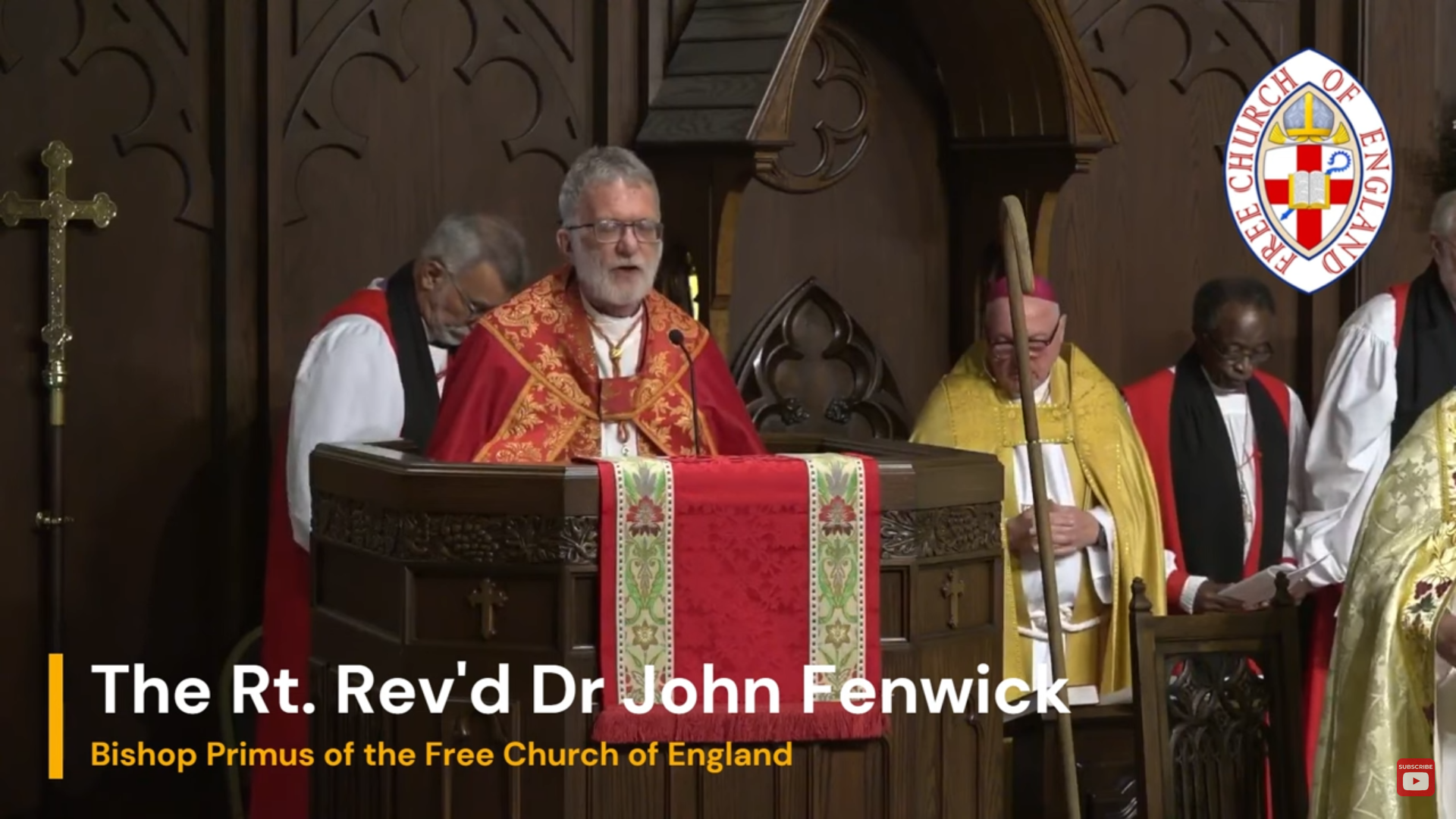
There is no Archbishop, but one of the Bishops is elected as Bishop Primus (a title used in other parts of the Anglican Communion as well) and presides at meetings of Convocation. The Primus also speaks on behalf of the whole Church when occasion requires.
What is the 'Evangelical Connexion'?
The Free Church of England is required by its Declaration of Principles to ‘maintain communion with all Christian Churches’ and to ‘set forward, so far as in it lieth, quietness, peace and love among all Christian people’. How that is given expression will obviously vary according to place and circumstances. In the present situation in the UK we believe that we can fulfil these requirements by engaging with other Churches and in the current Churches Together instruments. However, we do not believe that this involves doctrinal compromise; on the contrary, we see it as an opportunity to witness to others who profess to be Christians concerning the centrality of the Cross and the supreme authority and sufficiency of Scripture as the Word of God.
In 2003 a number of clergy (most of them relatively new to the Free Church of England) left – giving as their reason their objection to the outward-looking stance that the Church was taking. They formed a group of congregations calling themselves ‘The Evangelical Connexion’. Since then, of the group of churches that left, two have returned to the Free Church of England. Five congregations, however, remain institutionally separate. Since 2003, through prayer and dialogue, we have sought reconciliation and reintegration and earnestly hope that God will soon bring this about for our mutual encouragement and for the sake of the witness of his Church.